Trending

A small living room usually gets one light: the ceiling pendant, switched on at the door, doing the work of six. It is the reason so many compact rooms feel flat and slightly gloomy, however carefully you chose the sofa. Layering lighting simply means using several light sources of different strengths and heights instead of one, so the room has depth and you can shift its mood without moving a thing. No electrician required, and no bigger room either.
Almost every good lighting scheme in a small space comes down to three layers. Get them in the right order and the room will feel warmer, calmer and considerably more generous than its square metres suggest.
Build them in that order. Choose your ambient sources first, then add task light where you sit, then finish with one or two accents. If you buy accent lights first you will end up with a room that looks lovely in photographs and unusable at eight in the evening.
Three to five light sources is usually plenty for a small living room. If you can see a bare bulb from where you sit, it needs a shade or a lower position.
The quickest improvement you can make is to stop using the pendant at full strength. Fit a dimmable bulb, or replace the shade with something that diffuses light downwards and outwards rather than blasting it at the ceiling.
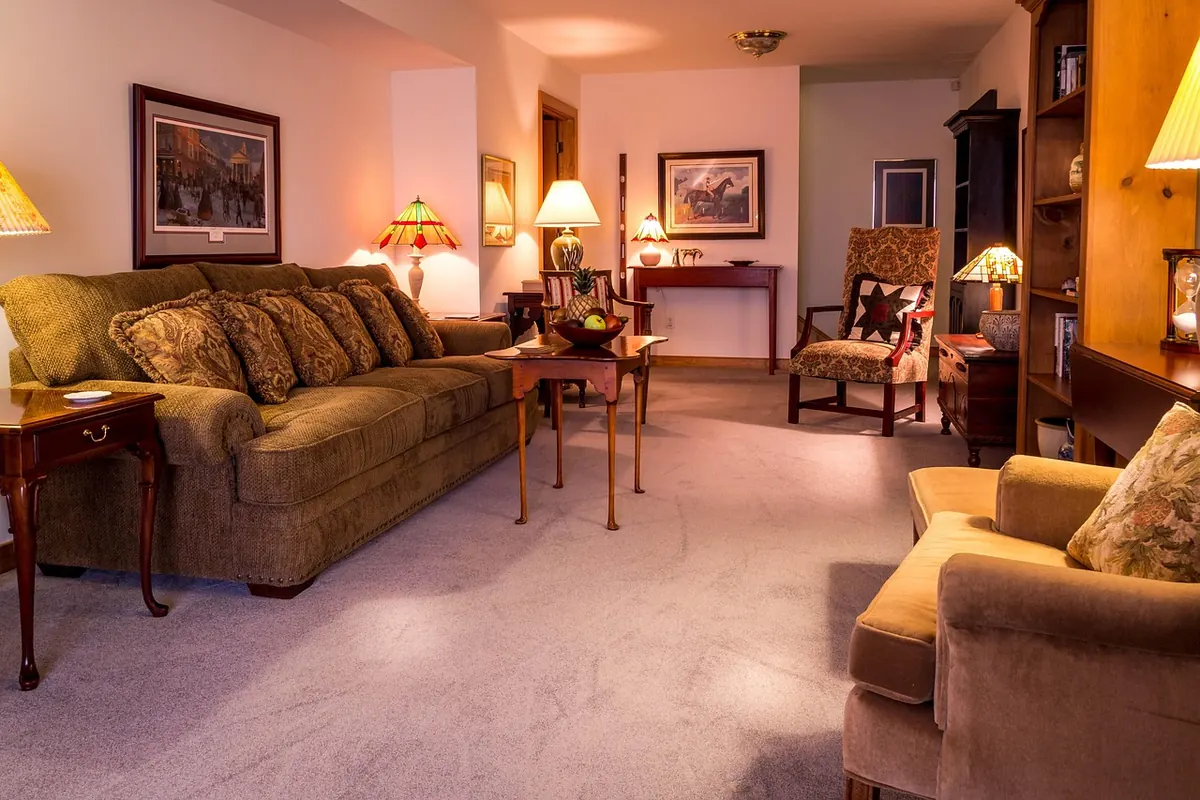
Then add a floor lamp in the darkest corner and a table lamp on the sideboard or windowsill. Two or three gentle sources at different heights read as daylight bouncing around a room, which is what makes a space feel bigger. A single bright source reads as a spotlight on a small stage.
In a narrow room, place lamps along the longer walls rather than the short ones. Light washing across the width makes the room feel wider; light stacked at both ends makes it feel like a corridor.
Task lighting is where most small rooms fall down, because people try to make one lamp do everything. If you read or work in a particular chair, that chair needs its own light.
The rule is simple: the light should come over your shoulder or from the side, so it lands on the page or your hands rather than in your eyes. A table lamp beside the sofa is fine if the shade sits roughly at eye level when you are seated. An arc or swing-arm floor lamp works better if the seat is deep or the side table is crowded.
If you sometimes work from the sofa, a rechargeable clip-on lamp on a laptop stand or a slim floor lamp behind you will do far more for your comfort than turning the ceiling light up. Light coming from directly in front of you creates glare on a screen; light from behind removes it.
Accent lighting is the layer people skip, and it is the one that makes a small room look considered. A picture light, a slim shelf light, a plug-in wall sconce or a small uplighter tucked behind a large plant all do the same job: they break the room into a foreground and a background.
Keep accent lights dimmer than everything else and point them at something worth looking at — a textured wall, a stack of books, a print. A cheap uplighter aimed at a blank ceiling just creates an odd glow. Aimed up through the leaves of a fern, it turns a dark corner into the most interesting part of the room.
Colour temperature is measured in kelvin, and it matters more than most people expect. For a living room, look for bulbs around 2700K, which is a warm, slightly golden white. Anything at 4000K or above is closer to office lighting and will make even a well-styled room feel clinical.
The most common error is mixing temperatures. You buy a warm bulb for one lamp and use whatever was in the drawer for the next, and the room looks subtly wrong without anyone being able to say why. Buy the same colour temperature for every fitting in the room — write it on your phone if you need to.
Ignore wattage as a measure of brightness and look at lumens instead. For a table lamp in a small room, somewhere in the region of 400 to 800 lumens is usually comfortable. And if you fit a dimmer, check that both the switch and the bulbs are LED-compatible; buzzing or flickering is almost always a mismatch rather than a fault.
You do not need to rewire anything to get four layers of light. Plug-in fittings have improved enormously, and they suit small rooms where you would rather not give up a socket permanently.
Take a little care with the practical side. Don't run cables under rugs or across walkways where they will be pinched or tripped over, avoid plugging several extension leads into one another, and check your tenancy agreement before drilling into walls.
Then use the layers rather than switching everything on at once. Bright ambient with task light is for evenings when you are reading; low ambient with one accent is for music and conversation. A small living room with four controllable light sources feels far larger than the same room with one switch, because your eye has somewhere to travel. Start with the lamp you already own, move it somewhere new, and see what changes.
Photo: JamesDeMers / Pixabay